With the Galaxy S10, Samsung celebrates its
10th anniversary Galaxy S phone by going big and bold. How bold? Each of the four new Galaxy S10 models is more impressive than the last: there’s the cheaper S10E ($750, £669, AU$1,199), the Galaxy S10 ($900, £799, AU$1,349), S10 Plus ($1,000, £899, AU$1,499) and Galaxy S10 5G, the brand’s first 5G phone.
This is Samsung seeking to whip up excitement, roar back in sales and defend its title as the world’s top smartphone brand. But the Galaxy S10 phones also represent a quest for perfection.
What does “perfection” mean to Samsung in 2019? An edge-to-edge screen with teeny-tiny bezels. The (remarkable) ability to wirelessly charge another device. An Infinity-O display that cuts a small circle (or oval) to make room for front-facing cameras. The world’s first ultrasonic in-screen fingerprint reader, which unlocks the Galaxy S10 using sound waves. Up to four rear cameras. Up to 1TB of built-in storage. The all-new One UI . Android Pie. A cutting-edge Snapdragon 855 processor. And, in one case, 5G capabilities.
Samsung also lays claim to a screen advancement that reduces blue-light emissions, which studies have shown can slow or halt the production of melatonin, the hormone that signals our brain that it’s time for bed.
Video: New Galaxy S10 phones pile on sweet specs
This is an impressive list of changes, but when I held them in my hands (except for the 5G model, which we couldn’t touch), the Galaxy S10 phones looked and felt extremely familiar. That’s not a bad thing at all. It means the camera “notch” stays out of the way, and that the edge-to-edge screen feels natural. And yes, you still get a headphone jack. Where Apple dramatically retooled the iPhone X by removing its signature home button and adding a screen notch, Samsung opted for an unbroken continuum. The Galaxy S10 simply picks up where the Galaxy S9 left off.
One thing does startle me though, and that’s the fact that none of the four new Galaxy S10 phones has 3D face unlock. The 5G model will come with a 3D depth-sensing camera on the front and back, but that will only assist with photography and AR, not with the iPhone XS-style of unlocking your phone with your face. (More on this in the fingerprint unlocking section below
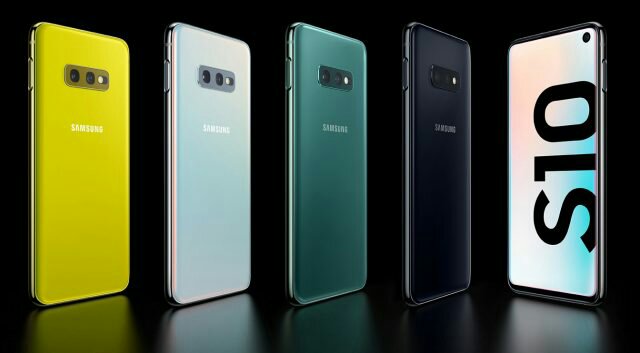
Preorders for all but the 5G phone began on Feb. 21, for a March 8 release date. Each preorder comes with a free set of
Galaxy Buds as a gift.
Keep reading for details on the four new Galaxy S10 phones, how wireless power sharing works, some new camera features and software changes like the in-screen fingerprint reader and One UI. You’ll find the full specs comparison at the very end. Let’s go!
Video: Galaxy S10 features: New cameras, colors and fingerprint sensor
Galaxy S10: The baseline model ($900)
The I-hate-to-call-it-standard Galaxy S10 is a natural entry point because it is the standard-bearer of the S10 family. It all starts with a 6.1-inch screen in a relatively compact frame thanks to the slim bezels around the sides. Samsung boasts that this is the first screen to earn HDR10+ certification. HDR10+ is Samsung’s format that competes with Dolby Vision.
The S10 gets you three rear cameras — a 16-megapixel ultrawide sensor with fixed focus, a main 12-megapixel dual aperture wide-angle lens with OIS, and a 12-megapixel telephoto lens with OIS that can achieve 2x optical zoom. That means you’re able to take portrait photos and photos from any of the sensors, just by toggling on the screen.
The Galaxy S10 and S10 Plus debut the world’s first ultrasonic in-screen fingerprint scanner.
 SCITECH